Kod Kuno Cina yang Masih Mengawal Segalanya u2014 Yin, Yang & 8 Simbol
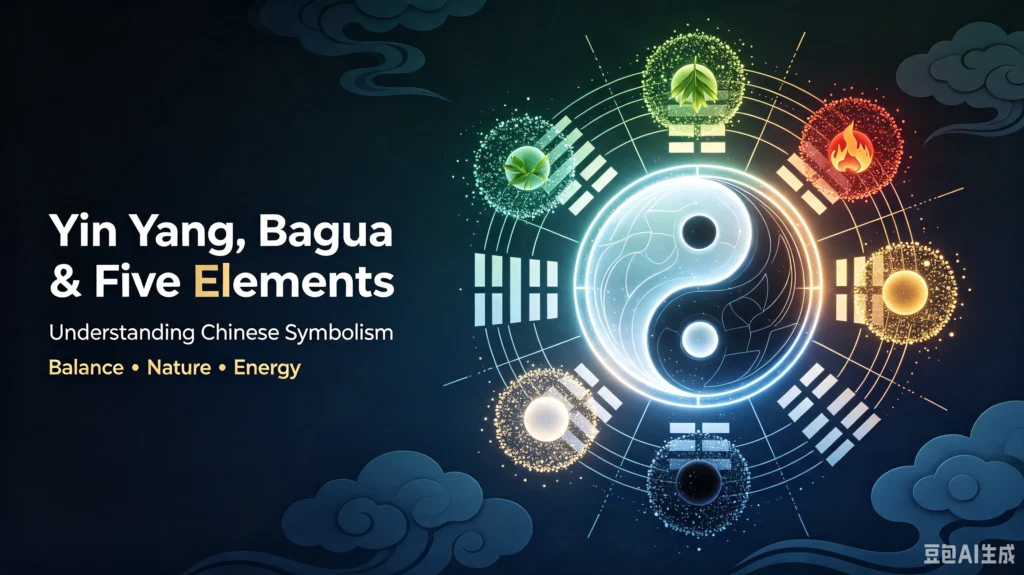
Yin-Yang, Five Elements & the Eight Trigrams: A Visitor’s Guide to China’s Cosmic Philosophy
Understanding 3,000 Years of Chinese Philosophy — From TCM to Feng Shui
📖 Why Does Any of This Matter?
Yin-Yang is not a religion or superstition. It is a philosophical framework — a way of understanding that everything in the universe exists in dynamic pairs of opposing but complementary forces. Neither side is good or evil. Both are necessary. Both define each other.
☯ Part 1 — Yin and Yang (阴阳 Yīn Yáng)
Yin vs Yang — At a Glance
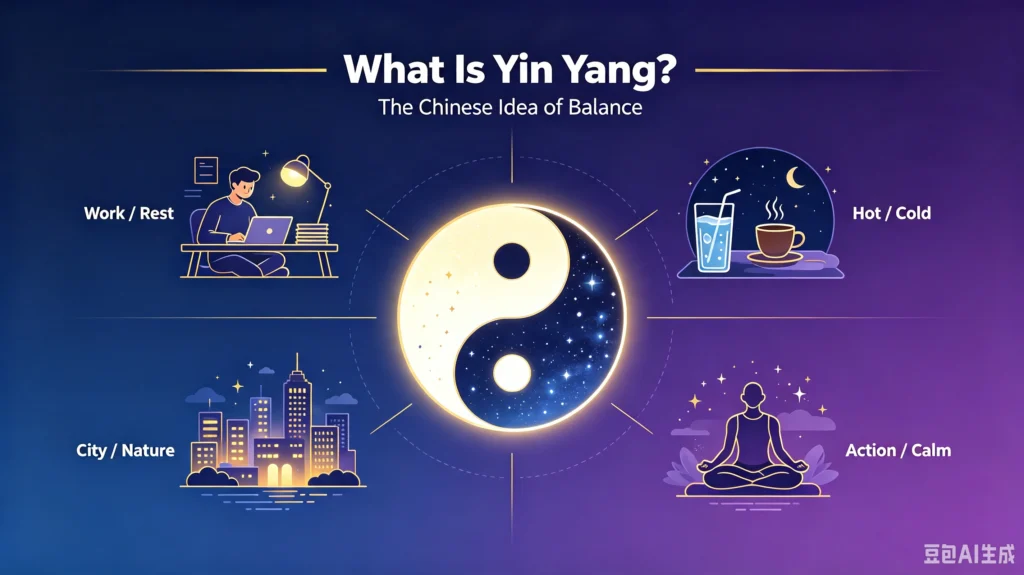
Two fundamental forces that exist in everything. Neither is good or evil. Both are necessary.
☽ YIN 阴
Dark · Night · Moon
Cold · Winter · Stillness
Feminine · Receptive · Soft
Earth · Below · Dense
Water · Flowing Downward
Passive · Rest · Sleep
☀ YANG 阳
Light · Day · Sun
Hot · Summer · Activity
Masculine · Active · Hard
Heaven · Above · Expansive
Fire · Rising Upward
Active · Motion · Growth
The Key Idea: Balance, Not Battle
The most common Western misunderstanding is seeing Yin-Yang as a conflict — light vs. dark, good vs. evil. That is NOT the concept. Yin and Yang are interdependent partners in constant transformation. Too much of either creates imbalance — and imbalance is what causes problems.
Where You Will See Yin-Yang in China
- Chinese medicine clinics: Doctors discuss Yin-Yang constitution and prescribe herbs accordingly
- Tai Chi (太极拳): The slow circular movements embody Yin-Yang — hard and soft, movement and stillness
- Feng Shui: Interior design and architecture arranged to balance Yin-Yang energy flow
- Chinese cooking: Foods classified as Yin (cooling: watermelon, cucumber, green tea) or Yang (warming: ginger, garlic, lamb, chilli)
- Temple architecture: Oriented to balance Yin (north, shadow, water) and Yang (south, sun, fire)
- Martial arts: Kung fu and Tai Chi cultivate and direct Qi (life energy) through Yin-Yang balance
平安好医生 (Ping An Good Doctor) — China’s largest online TCM consultation platform. Book consultations with Chinese medicine doctors who diagnose Yin-Yang imbalances. Available in Chinese; works with foreign phone numbers.
薄荷健康 (Boohee Health) — Nutrition app that classifies foods as Yin/Yang cooling or warming, not just calories. Popular with Chinese health-conscious users.
Find guides for setting up Chinese health apps at ichingo.app
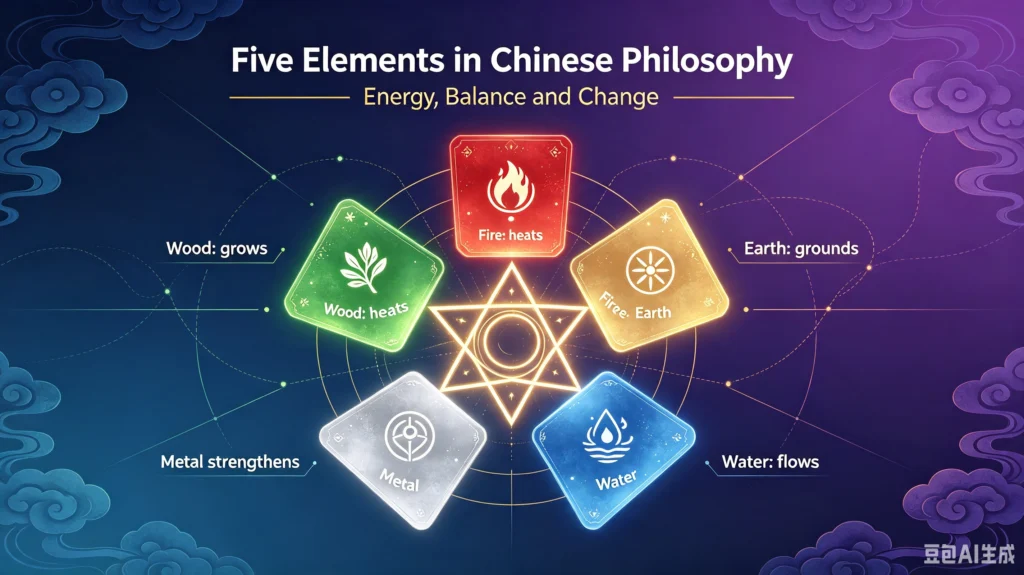
🔥 Part 2 — The Five Elements (五行 Wǔ Xíng)
Understanding the Five Elements
Yin-Yang describes the two fundamental forces. The Five Elements describes how these forces express themselves through five dynamic states: Wood, Fire, Earth, Metal, and Water. This framework is central to Chinese medicine, astrology, and fortune-telling.
☰ Part 3 — The Eight Trigrams (八卦 Bā Guà)
What Are the Eight Trigrams?
The Eight Trigrams (Ba Gua) is the architecture built upon Yin-Yang. Each trigram is a stack of three lines, where each line is either solid (Yang) or broken (Yin). Three lines with two possible states = 8 combinations = Eight Trigrams. These symbols — first described in the I Ching around 800 BC — represent eight fundamental states of reality.
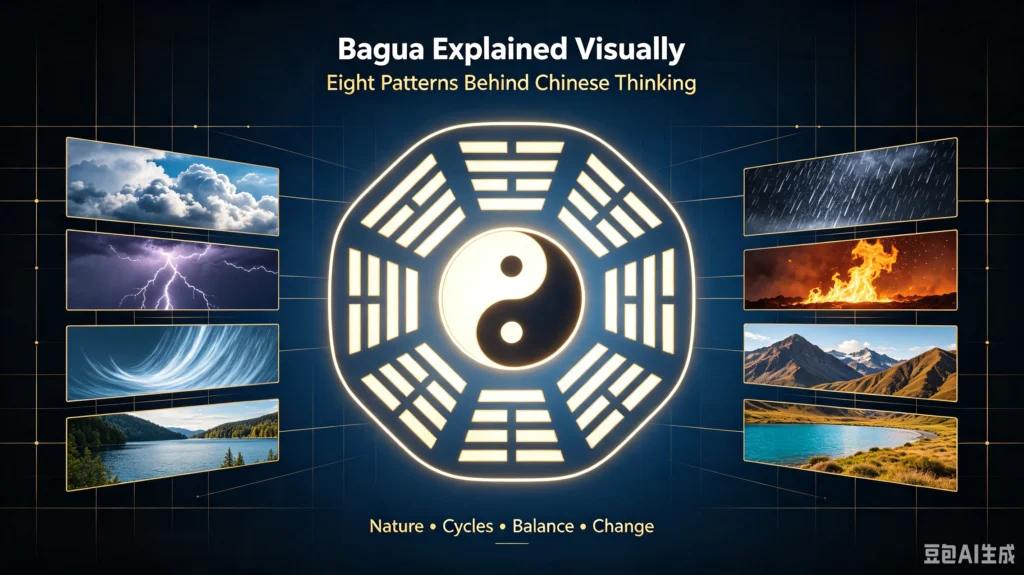
The Bagua Map — Eight Life Areas
In feng shui, the eight trigrams are arranged in an octagon (the Bagua Map), each assigned to a compass direction and a life area. This map is used to analyze homes, offices, and cities to optimize the flow of Qi (life energy).
🏛️ Part 4 — How Yin-Yang & Ba Gua Shape Modern Chinese Life
4A. Traditional Chinese Medicine (TCM)
TCM — still practiced by hundreds of millions and covered by China’s national health insurance — is entirely built on Yin-Yang and Five Elements theory. When a TCM doctor takes your pulse with three fingers on each wrist, they are reading six organ systems and their Yin-Yang balance.
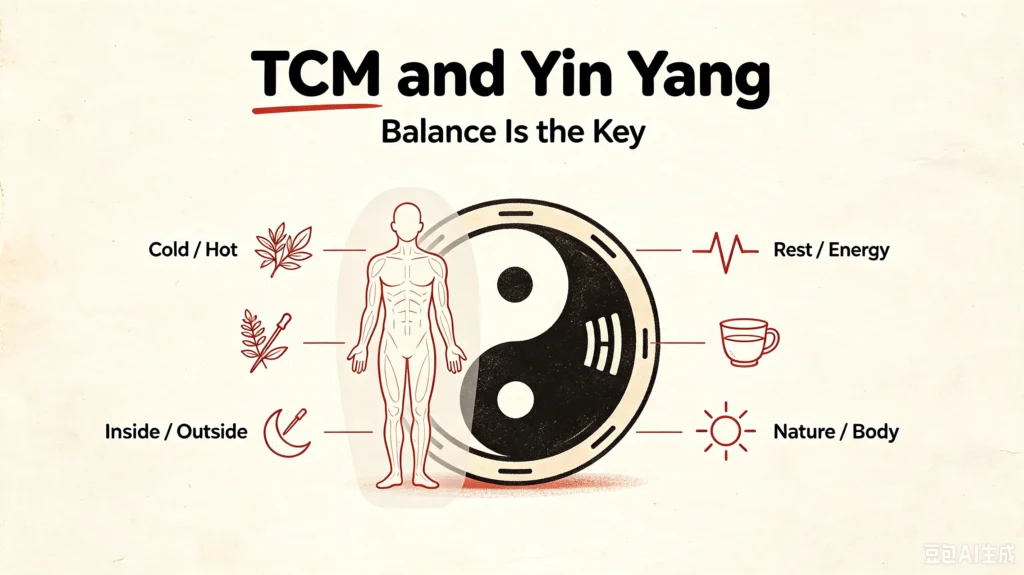
- Yang excess: Inflammation, fever, red face — treated with cooling Yin-tonifying herbs
- Yin deficiency: Night sweats, dry mouth, restlessness — treated with Yin-nourishing foods
- Yang deficiency: Cold limbs, fatigue, pale face — treated with warming foods (ginger, cinnamon, lamb)
- Qi stagnation: Stress, bloating, emotional tension — treated with Qi-moving herbs and acupuncture
平安好医生 (Ping An Good Doctor) — Book TCM doctors online; available nationwide with English interface option
好大夫在线 (Hao Da Fu) — China’s largest doctor-booking platform with TCM specialists. Foreigners can register with a non-Chinese phone number.
Find full registration guides for these apps at ichingo.app
4B. Feng Shui — Ba Gua in Architecture
Feng Shui (wind-water) is the practice of arranging spaces to optimize Qi flow using Bagua principles. Many Chinese businesses and families seriously consult feng shui masters when choosing offices and homes.
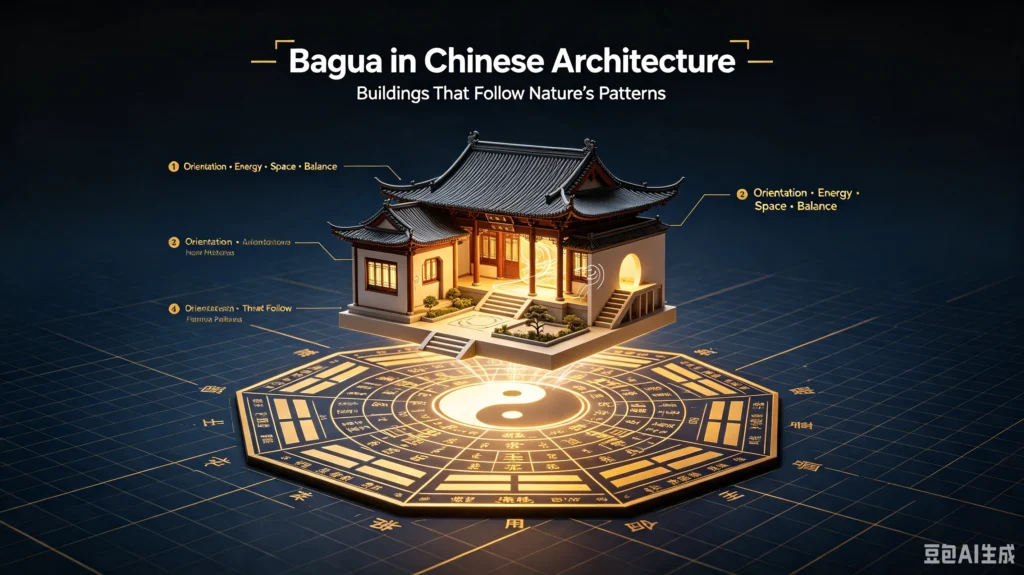
- The HSBC Tower in Hong Kong: Famously designed with feng shui consultation — two escalators angle toward the harbor to channel wealth energy
- Many Shenzhen and Beijing office buildings: Front door direction and lobby layout determined by feng shui masters
- Red decorations at Chinese New Year: Red is Yang color — active, auspicious, fire energy — chosen deliberately
- Mirror placement: Mirrors redirect or amplify Qi — never place one directly facing the front door
4C. Choosing Auspicious Dates (择日)
Selecting a lucky date for weddings, business launches, and major decisions is extremely common in China. The process uses Ba Gua, Five Elements, and the lunar calendar to identify dates that align favorable energy with the individuals involved.
- Wedding dates cluster heavily around numerologically favored dates: 6/6, 9/9, 8/8, dates with lucky sounds in Chinese
- Business contracts are often signed on dates chosen for their elemental and Bagua alignment
- Moving house is almost always done on an auspicious date — moving on a ‘wrong’ day is genuinely believed to bring bad luck
🧭 Part 5 — Visitor’s Practical Guide
Where You’ll Encounter These Symbols in China
Three Things That Will Change How You See China
- When a Chinese person says ‘I need to find balance’ or ‘this food is too cooling for me’, they are describing Yin-Yang literally — not as a metaphor. The philosophy is embedded in everyday language.
- The number 8 is extremely lucky in China because it sounds like 发 (prosperity) — this is Yang energy sound symbolism. The number 4 is unlucky because it sounds like 死 (death) — Yin energy at its most extreme.
- When a Chinese building has mirrors, plants, water features, or specific colors in specific locations — these are almost always intentional feng shui choices, not random decoration.
• Understand why a TCM doctor asks about sleeping patterns, diet, and emotions all at once
• Make sense of why Chinese people choose specific dates for weddings and business launches
• Appreciate the intentional design of Chinese temples, gardens, and public spaces
• Connect more meaningfully with Chinese friends who take these concepts seriously
🎯 Final Thoughts
Yin-Yang and Ba Gua are 3,000 years old — and still very much alive. In China’s hospitals, homes, boardrooms, and temples, these ideas shape real decisions every day. Understanding them is not about accepting ancient superstition; it is about understanding one of humanity’s most sophisticated frameworks for making sense of a complex world.
The next time you see a ☯ symbol — on a temple gate, a medicine bottle, or a kung fu poster — you’ll know you’re looking at something that has shaped the most populous civilization in human history for three millennia.
For more China culture guides, practical app recommendations, and travel tips, visit ichingo.app — your complete toolkit for understanding and traveling China.
📥 Download Complete PDF Manual
Multi-Language • Offline Printable • Full Illustrations Included